The Future is Already Here...
You Just Haven't Noticed Yet

Dotting Tomorrow's Tech Today

Latest Blog Post

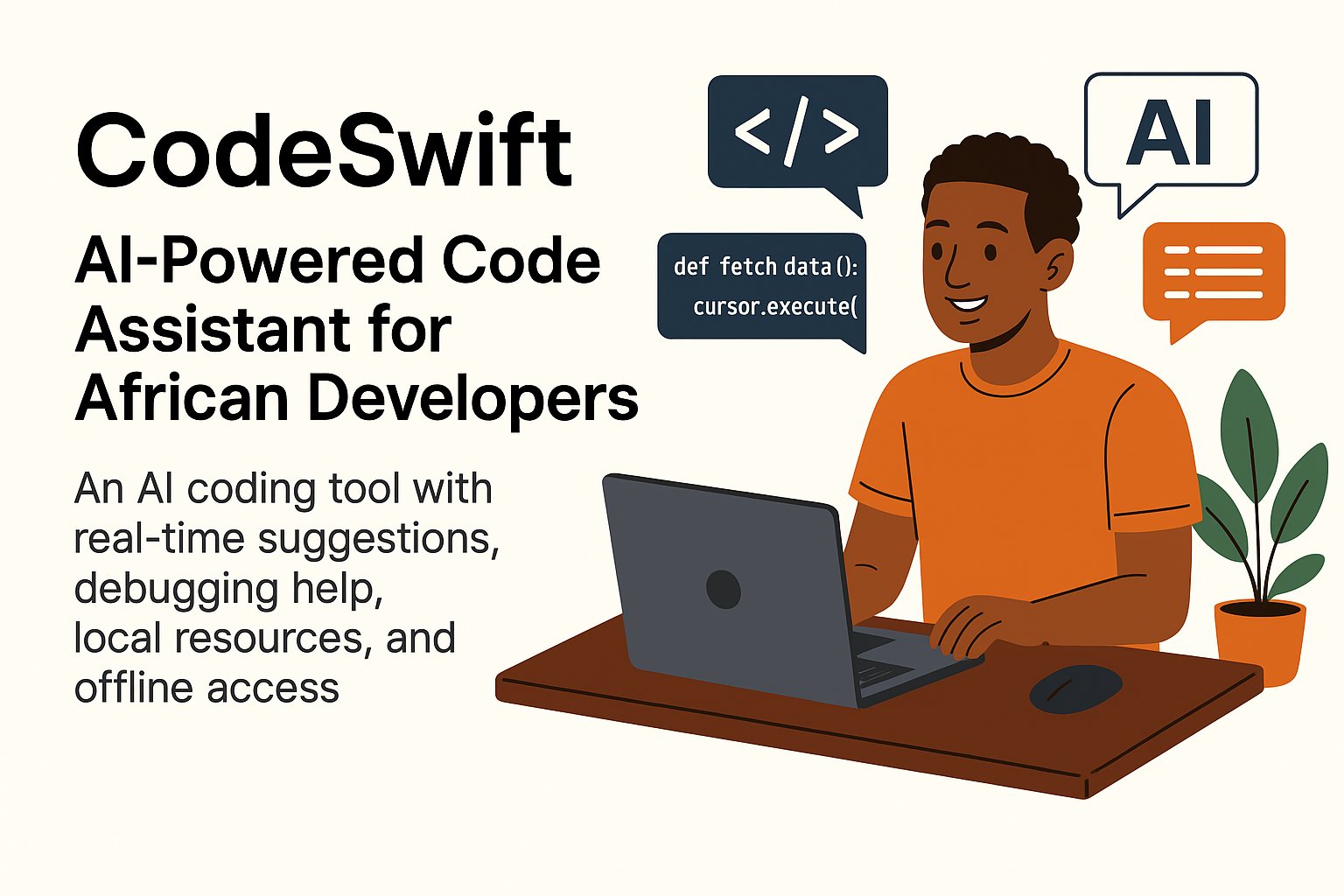
CodeSwift โ€” AI-Powered Code Assistant for African Developers

CodeSwift โ€” AI-Powered Code Assistant for African Developers

๐Ÿง  Business Concept: CodeSwift is a smart code assistant platform built specifically to support African software developers, startups, and coding students. It combines AI-powered code generation, debugging help, and localized learning resources all in one. Think of it as a hybrid of GitHub Copilot, Stack Overflow, and W3Schools, but localized for the African tech ecosystem. ๐Ÿ”ง Core Features: AI Code Helper: Real-time code suggestions and completions in Python, JavaScript, Django, SQL, etc. Fix bugs and generate documentation automatically. Local Dev Hub: Forums and community boards for African developers to collaborate and share tips. Local languages and broken English options to help beginners. Project Templates: Ready-to-deploy templates for fintech, e-commerce, school portals, and other in-demand African apps. Offline Mode: Lightweight desktop or mobile app that works offline (great for areas with poor internet access). Earn While You Build: Developers can monetize their snippets, courses, and project templates through a marketplace. ๐Ÿš€ Why It Matters: Many African developers face challenges like poor internet, lack of local mentorship, or platform access issues. CodeSwift fills that gap by offering accessible, affordable, and localized coding assistance. ๐Ÿ’ธ Monetization Model: Freemium access for students and early learners Pro subscription for startups and teams Marketplace commission on templates, code packs, and tutorials Brand sponsorships for dev events and hackathons ๐ŸŒ Vision: Empowering the next generation of African software developers by making coding support smarter, faster, and tailored to their environment.


Mautin
Mautin

Grammarly to acquire email startup Superhuman in AI platform push

Grammarly to acquire email startup Superhuman in AI platform push

Grammarly has signed a deal to acquire email efficiency tool Superhuman as part of the company's push to build an artificial intelligence-powered productivity suite and diversify its business, its executives told Reuters in an interview. The San Francisco-based companies declined to disclose the financial terms of the deal. Superhuman, once an exclusive email tool boasting a long waitlist for new users, was last valued at $825 million in 2021, and currently has an annual revenue of about $35 million .Grammarly's acquisition of Superhuman follows its recent $1 billion funding from General Catalyst, which gives it dry powder to create a collection of AI-powered workplace tools. Founded in 2009, the company has over 40 million daily users and an annual revenue exceeding $700 million. It's working on a name change with an ambition to expand beyond grammar correction. Superhuman, with over $110 million in funding from investors including IVP and Andreessen Horowitz, has been trying to create an efficient email experience by integrating AI. The company claims its users send and respond to 72% more emails per hour, and the percentage of emails composed with its AI tools has increased fivefold in the past year. It also faces growing competition as email giants from Google to Microsoft are adding more AI features. "Email continues to be the dominant communication tool for the world. Professionals spend something like three hours a day in their inboxes. It's by far the most used work app, foundational to any productivity suite," said Shishir Mehrotra, CEO of Grammarly. "Superhuman is the obvious leading innovator in the space." Last year’s purchase of startup Coda gave Grammarly a platform for AI agents to help users research, analyze, and collaborate. Email, according to Mehrotra who co-founded Coda, was the next logical step. Superhuman CEO Rahul Vohra will join Grammarly as part of the deal, along with over 100 Superhuman employees. “The Superhuman product, team, and brand will continue,” Mehrotra said. “It’s a very well-used product by tens of thousands of people, and we want to see them continue to make progress.” Vohra said that the deal will give Superhuman access to “significantly greater resources” and allow it to invest more heavily in AI, as well as expand into calendars, tasks, and collaboration tools. Mehrotra and Vohra see an opportunity to integrate Grammarly’s AI agents directly into Superhuman, and build the tools for enterprise customers. The vision is for users to tap into a network of specialized agents, pulling data from across their digital workflows such as emails and documents, which will reduce time spent searching for information or crafting responses. The company is also entering a crowded space of AI productivity tools, competing with tech giants such as Salesforce and a wave of startups.

Samuel
Samuel

RUBY ON RAILS

RUBY ON RAILS

Ruby, particularly through its most popular web framework Ruby on Rails, has had a huge impact on web development by making it faster, more enjoyable, and less complex for developers. Before Rails gained popularity, building web applications required a lot of repetitive work, boilerplate code, and configuration. Ruby on Rails introduced a new way of thinking that emphasized convention over configuration, meaning developers could follow set patterns and write less code to achieve more functionality.   One of the most important ways Ruby on Rails changed web development is by promoting rapid development through scaffolding, which allows developers to generate basic parts of an application—like models, views, and controllers—automatically. This feature helped beginners and experts alike build prototypes and full applications in record time. The Ruby language itself also played a major role because of its clean, readable syntax, which makes it feel more like writing plain English than traditional code.   Rails introduced or popularized the MVC (Model-View-Controller) architectural pattern in web development, which separates the application into layers of responsibility. This separation helps developers organize their code better, makes it easier to maintain, and encourages a clear flow of data and control. The Active Record ORM that comes with Rails simplifies database interaction by allowing developers to use Ruby code to handle database operations instead of writing raw SQL.   Another major contribution is how Rails handles routing, RESTful architecture, and form handling. It simplified the process of mapping URLs to functions, handling user input, and managing CRUD operations in a way that felt natural and minimal. Features like migrations also allow developers to evolve their database schema alongside their application code without manually managing database changes.   Rails also emphasizes developer happiness and productivity. With features like hot code reloading, meaningful error messages, automated testing tools, and a vast library of gems (Ruby packages), developers can quickly build powerful applications and customize them with minimal effort. The strong testing culture encouraged by Rails has also improved code quality across the board, with test-driven development becoming a common practice.   Ruby on Rails also made deployment smoother, especially with the rise of platforms like Heroku, which was originally built with Rails apps in mind. This allowed developers to get their applications online with just a few commands, which was a game-changer compared to older deployment methods that required heavy setup.   Overall, Ruby and Rails made web development more human-friendly, enjoyable, and efficient. It inspired a new generation of frameworks in other languages to focus more on developer experience, productivity, and best practices. By abstracting complexity and introducing clear conventions, Ruby on Rails changed the culture of web development, making it easier for individuals and teams to build, scale, and maintain modern web applications.

Olalekan
Olalekan

DJANGO (Python Web Development Framework)

DJANGO (Python Web Development Framework)

Django is a high-level Python web framework that has significantly changed the way web development is approached by promoting rapid development, clean design, and reducing the amount of code developers need to write. Before Django, many developers had to manually handle repetitive tasks like user authentication, URL routing, and database operations, often leading to inconsistencies and inefficiencies. Django introduced a standard way of building web applications by following the "Don't Repeat Yourself" (DRY) principle, which encourages code reuse and modularity.   One of the biggest contributions of Django is its powerful Object-Relational Mapping (ORM) system, which allows developers to interact with the database using Python code instead of writing complex SQL queries. This makes it easier for beginners and also improves productivity for experienced developers by simplifying data handling. With Django, creating models, managing database migrations, and performing queries becomes seamless and less error-prone.   Django also includes a built-in admin interface, which automatically generates a user-friendly backend dashboard for managing database records. This feature alone saves hours of development time and allows developers to focus on the user-facing aspects of their applications. Security is another area where Django shines—it provides strong protection against common web vulnerabilities such as SQL injection, cross-site scripting (XSS), and cross-site request forgery (CSRF) out of the box, reducing the risk of security breaches.   The framework also encourages a clean and organized project structure, separating concerns into different components like models, views, and templates. This separation makes code easier to maintain, scale, and collaborate on in team environments. Django’s templating engine allows developers to build dynamic web pages with logic embedded in HTML while still maintaining readability and security.   Django has also made deploying applications easier by providing management commands and integration with various deployment platforms. Its scalability means that it can be used to build both small projects and large-scale applications. Moreover, the Django community is large and active, offering a wealth of reusable packages, plugins, and documentation that further reduce development time and effort.   Overall, Django has transformed web development by making it more accessible, faster, and secure. Its emphasis on simplicity, reusability, and convention has helped developers build robust applications without reinventing the wheel, setting a high standard for modern web frameworks.

Olalekan
Olalekan

Cloudflare launches tool to help website owners monetize AI bot crawler access

Cloudflare launches tool to help website owners monetize AI bot crawler access

Cloudflare has launched a tool that blocks bot crawlers from accessing content without permission or compensation to help websites make money from AI firms trying to access and train on their content, the software company said on Tuesday. The tool allows website owners to choose whether artificial intelligence crawlers can access their material and set a price for access through a "pay per crawl" model, which will help them control how their work is used and compensated, Cloudflare said. With AI crawlers increasingly collecting content without sending visitors to the original source, website owners are looking to develop additional revenue sources as search traffic referrals that once generated advertising revenue decline. The initiative is supported by major publishers including Condรฉ Nast and Associated Press, as well as social media companies such as Reddit and Pinterest. Cloudflare's Chief Strategy Officer Stephanie Cohen said the goal of such tools was to give publishers control over their content, and ensure a sustainable ecosystem for online content creators and AI companies. "The change in traffic patterns has been rapid, and something needed to change," Cohen said in an interview. "This is just the beginning of a new model for the internet." Google, for example, has seen its ratio of crawls to visitors referred back to sites drop to 18:1 from 6:1 just six months ago, according to Cloudflare data, suggesting the search giant is maintaining its crawling but decreasing referrals. The decline could be a result of users finding answers directly within Google's search results, such as AI Overviews. Still, Google's ratio is much higher than other AI companies, such as OpenAI's 1,500:1. For decades, search engines have indexed content on the internet directing users back to websites, an approach that rewards creators for producing quality content. However, AI companies' crawlers have disrupted this model because they harvest material without sending visitors to the original source and aggregate information through chatbots such as ChatGPT, depriving creators of revenue and recognition. Many AI companies are circumventing a common web standard used by publishers to block the scraping of their content for use in AI systems, and argue they have broken no laws in accessing content for free. In response, some publishers, including the New York Times, have sued AI companies for copyright infringement, while others have struck deals to license their content. Reddit, for example, has sued AI startup Anthropic for allegedly scraping Reddit user comments to train its AI chatbot, while inking a content licensing deal with Google.

Samuel
Samuel

Microsoft tells employees using AI is no longer optional, may impact performance reviews as more layoffs likely in July

Microsoft tells employees using AI is no longer optional, may impact performance reviews as more layoffs likely in July

Microsoft is reportedly mandating internal AI tool usage. It has also added AI tools as one of the factors in employee performance evaluations. The internal push to use AI tools comes amid reports of more lay-offs expected in July 2025. In Short: Microsoft wants its employees to use its AI tools It has asked managers to evaluate employees based on their AI usage The company is reportedly planning to cut off more jobs in July 2025 Microsoft wants its employees to use its artificial intelligence tool. Not just use itโ€”the company is reportedly planning to make AI tools one of the factors to evaluate performance of the employees. According to Business Insider, Microsoft is concerned about the low adoption rates of its own AI services and has therefore instructed managers to evaluate employees based on their use of internal AI tools.

Samuel
Samuel

โ† Page 3

Let's Talk

Do you want to learn more about how I can help your company overcome problems? Let us have a conversation.